
Why spot trading fits Hyperliquid in 2026
Hyperliquid spot markets offer a distinct alternative to traditional centralized exchanges and perpetual DEXs by prioritizing direct asset ownership and speed. Unlike perpetual contracts, which rely on funding rates and leverage, spot trading on Hyperliquid is strictly 1:1. You own the actual token, which eliminates the risk of liquidation and removes the complexity of funding rate calculations. This structure provides a cleaner trading environment for those who want to accumulate or trade assets without the overhead of derivative mechanics.
The platform’s underlying HyperCore engine addresses the latency issues that often plague decentralized spot trading. According to official documentation, HyperCore is capable of handling over 200,000 orders per second. This throughput ensures that spot orders execute with minimal slippage and near-instant finality, bridging the performance gap between CEXs and on-chain alternatives.
This combination of direct ownership and high-speed execution makes Hyperliquid spot particularly suitable for 2026’s market conditions, where traders seek transparency without sacrificing the speed required for active strategies.
Fund your account with USDC
Funding your Hyperliquid spot account is the first concrete step before placing any trades. The platform is built on its own Layer 1 blockchain, which means the deposit process is designed to be low-friction and immediate. Unlike traditional exchanges that require lengthy bank wire verifications, Hyperliquid allows you to bridge USDC directly from supported EVM chains.
You can deposit USDC from networks like Ethereum, Arbitrum, Base, or Optimism. The bridge mechanism ensures that your funds appear in your Hyperliquid wallet almost instantly, allowing you to start trading without waiting for external confirmations. This native integration is a core feature of the platform, making it efficient for active traders who need rapid access to capital.
Step 1: Connect your wallet
Navigate to the Hyperliquid interface and connect your Web3 wallet (such as MetaMask or Rabby). Ensure your wallet is connected to the specific network where you hold your USDC. This step establishes the link between your external funds and the Hyperliquid trading environment.
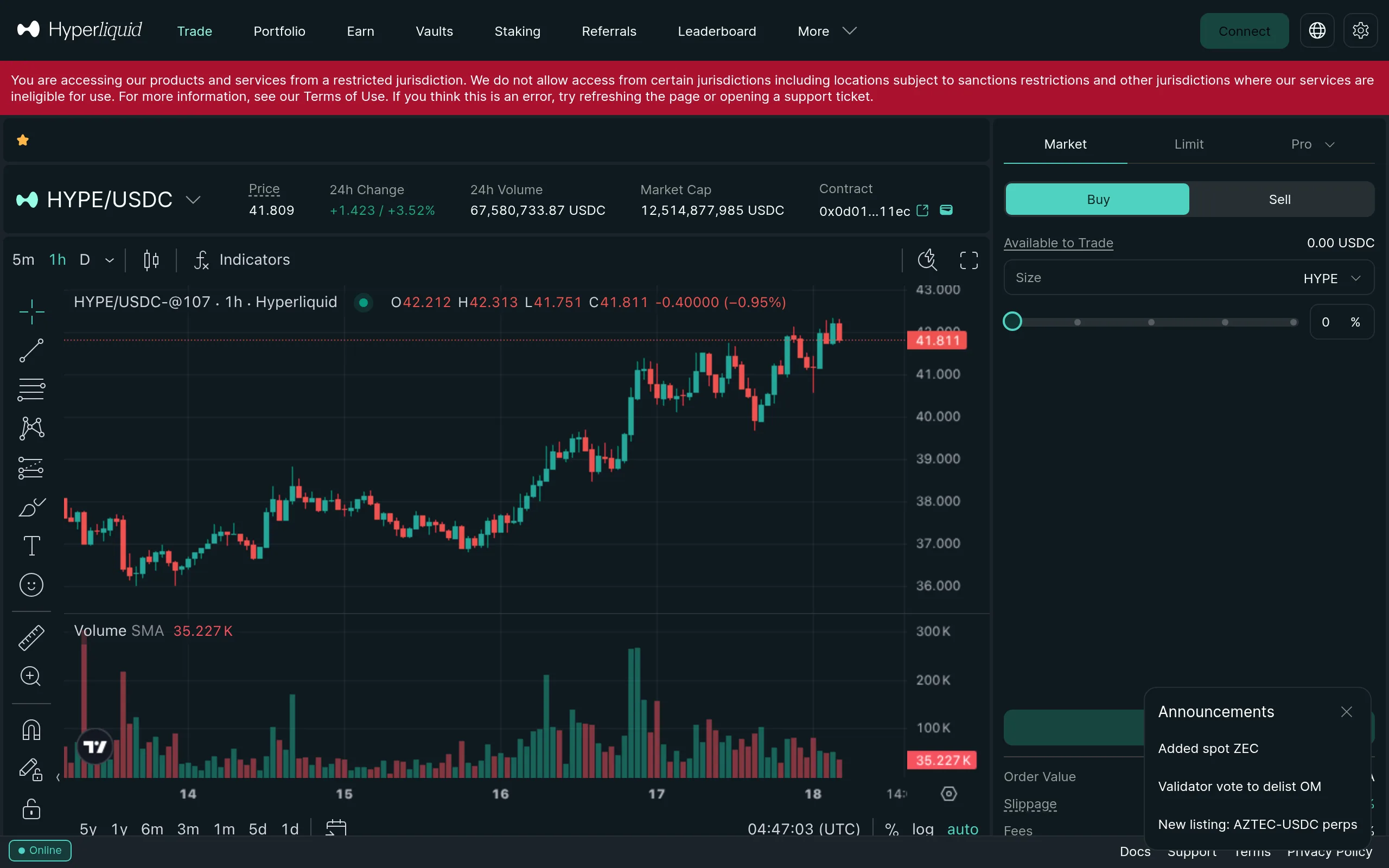
In the top navigation bar, click on the wallet or deposit section. Select "Deposit" and choose USDC as the asset. The interface will display a list of supported networks for bridging.
Select the blockchain where your USDC currently resides. Hyperliquid supports major EVM chains including Ethereum, Arbitrum, Base, and Optimism. Ensure you select the correct network to avoid sending funds to an incompatible address.
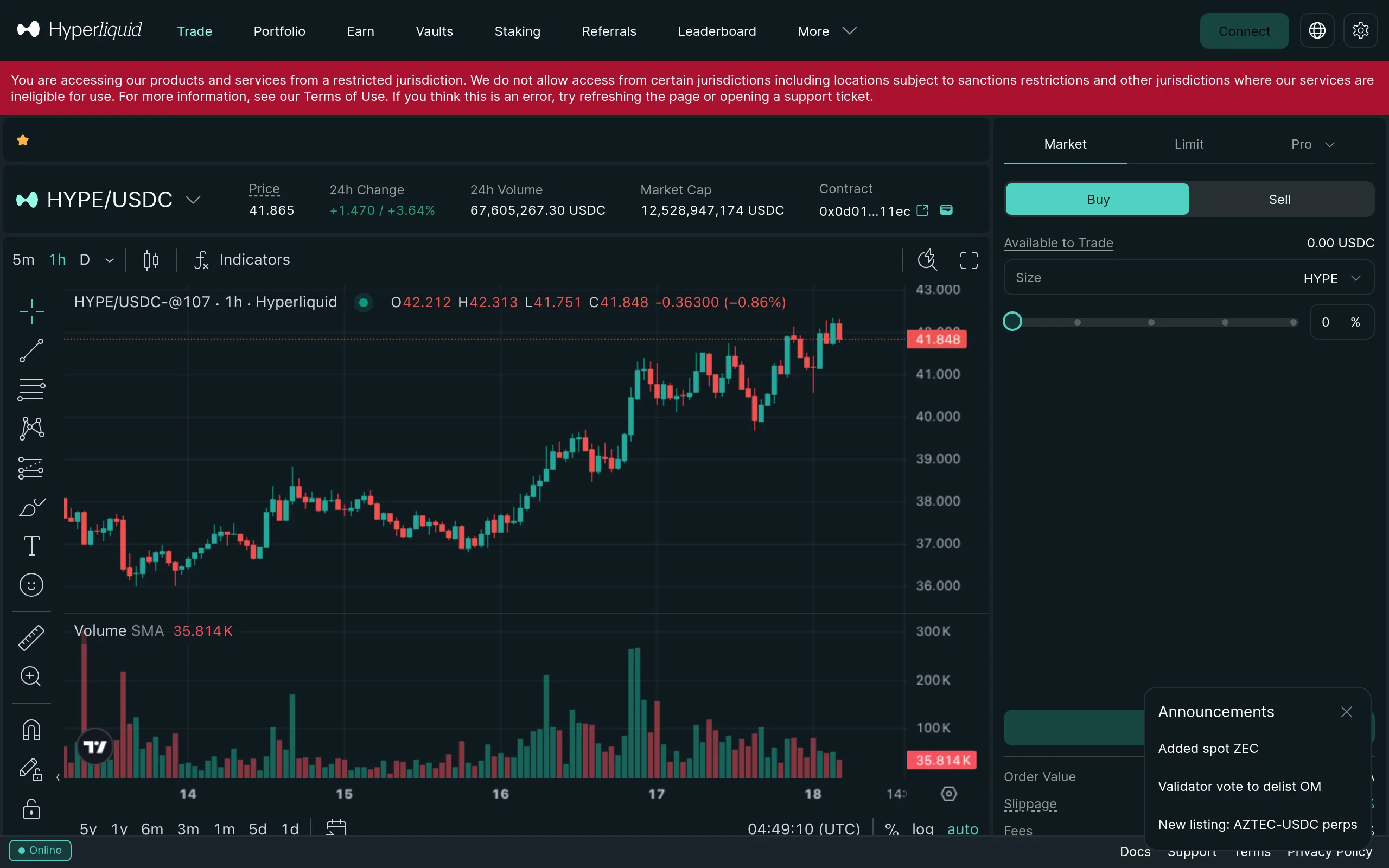
Review the deposit address and the network fee. Confirm the transaction in your wallet. Once the bridge processes the transaction, the USDC will appear in your Hyperliquid spot balance within seconds.
For the most up-to-date list of supported networks and any potential fee changes, refer to the official Hyperliquid announcements. The platform regularly updates its infrastructure to support new chains and improve deposit speeds.
Step 2: Verify your balance
Once the transaction is confirmed, refresh your dashboard to verify that the USDC balance has updated. You can now use these funds to place spot orders for cryptocurrencies, commodities, or indices available on the platform. Remember that spot trading requires you to have sufficient USDC in your account to cover the order value and any associated fees.
Place your first spot order
Spot trading on Hyperliquid differs fundamentally from perpetual futures. You are buying the actual token at a 1:1 ratio, which means there are no funding rates, no leverage, and no liquidation risk. The interface mirrors the speed of a centralized exchange but operates entirely on-chain. To place a spot order, you must plan around the trading terminal and distinguish between limit and market execution.

Locate the pair selector at the top of the trading terminal. Unlike perpetual markets, spot pairs do not display funding rates or open interest. Select the asset you wish to trade, such as USDC/USDT or ETH/USDC, to load the appropriate order book and chart data.
Hyperliquid offers two primary execution methods. A limit order allows you to set a specific price at which you want to buy or sell, ensuring you get your target rate but offering no guarantee of execution. A market order executes immediately at the best available price in the order book, prioritizing speed over price precision.
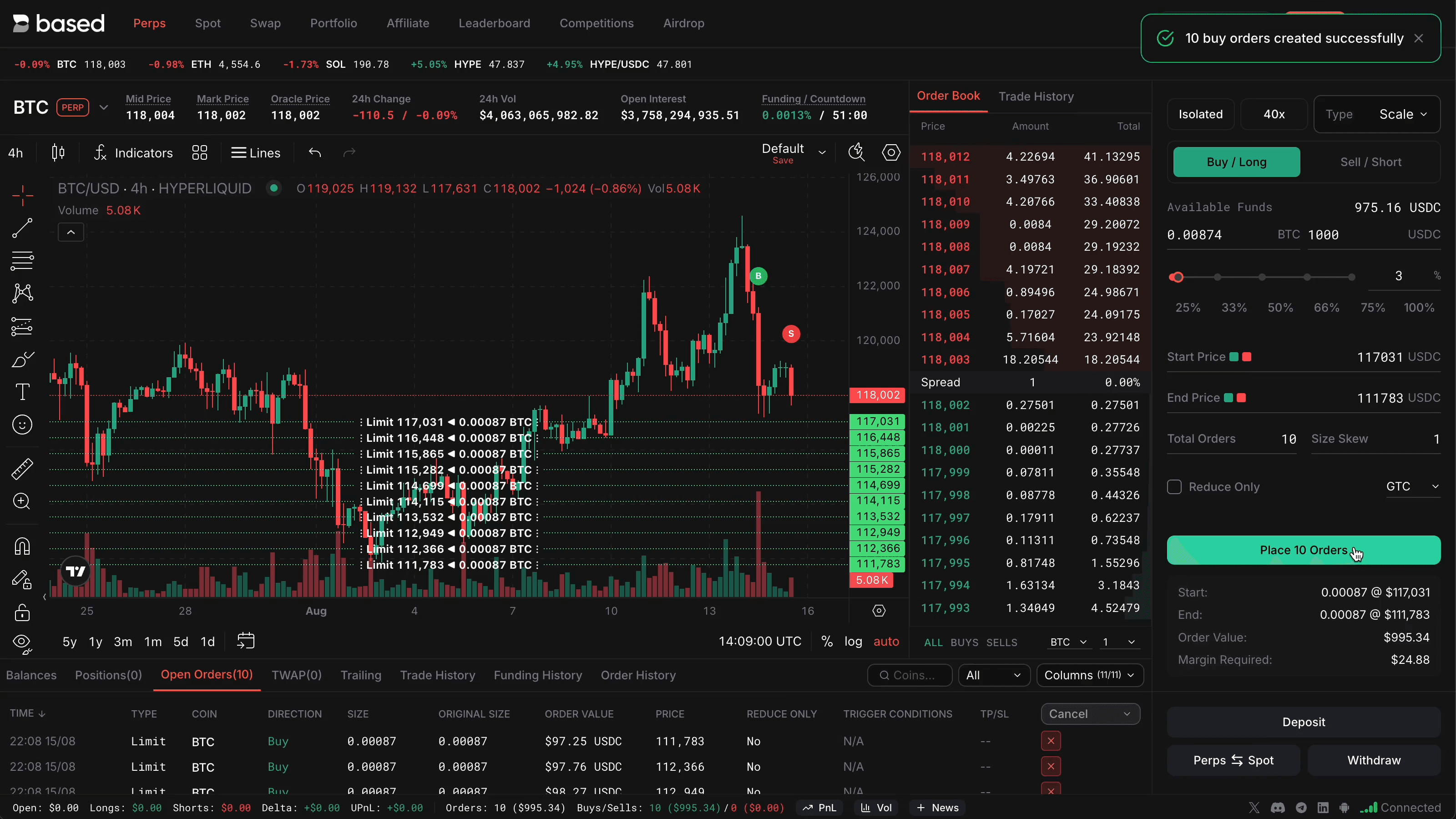
In the order panel, input the price per unit. For limit orders, this is your maximum buy or minimum sell price. Next, enter the size of the order in the base asset (e.g., amount of ETH) or use the percentage sliders to allocate a portion of your available USDC balance. Ensure you have sufficient collateral in your wallet to cover the trade plus network fees.
Double-check the order details, including the total cost and estimated fees. Spot trades on Hyperliquid settle instantly on-chain. Click the "Buy" or "Sell" button to submit the order. Your position will appear in the "Open Orders" tab until it is filled or canceled.
The interface updates in real time, reflecting on-chain liquidity. Because spot trading lacks the complexity of margin management, the focus remains strictly on price discovery and asset accumulation.
Compare Hyperliquid Spot to CEX Options
Hyperliquid operates as a non-custodial exchange, meaning you retain control of your private keys. This structural difference changes how you manage funds, assess risk, and execute trades compared to traditional Centralized Exchanges (CEXs). Understanding these distinctions helps you decide if the platform fits your trading workflow.
Custody and Security
On Hyperliquid, you trade from your own wallet. The exchange does not hold your assets in a shared pool. If the platform experiences downtime or technical issues, your funds remain safe in your wallet. In contrast, CEXs like Binance or Coinbase hold your assets in custody. While reputable CEXs undergo audits, you are exposed to counterparty risk, such as exchange insolvency or regulatory freezes.
Fees and Trading Costs
Hyperliquid charges a maker fee of 0% and a taker fee of 0.02% on spot trading. This is generally lower than the standard 0.1% taker fee found on major CEXs. However, you must also account for blockchain gas fees when moving funds. If you trade frequently, the lower exchange fees can offset the occasional network cost. For infrequent traders, the gas fees may negate the savings.
Asset Selection and Liquidity
Hyperliquid focuses on a curated list of high-volume assets. This simplifies the interface but limits your options. Major CEXs offer thousands of pairs, including many low-cap altcoins. If you trade established cryptocurrencies, Hyperliquid provides sufficient liquidity. For niche assets, a CEX remains the better venue.
| Feature | Hyperliquid | Binance | Coinbase |
|---|---|---|---|
| Custody | Non-custodial | Custodial | Custodial |
| Spot Maker Fee | 0% | 0.1% | 0.4% |
| Spot Taker Fee | 0.02% | 0.1% | 0.6% |
| Asset Count | Limited | Thousands | Hundreds |
| Regulatory Status | Decentralized | Licensed | Licensed |
Track HYPE price and market trends
Monitoring the native token requires separating short-term noise from structural shifts. Hyperliquid (HYPE) has shown significant volatility, recently trading near $71 as the market digests 2026 rally dynamics. You need reliable, real-time data to distinguish between a temporary dip and a trend reversal.
Start with live price tracking to establish your baseline. The following widget provides the current HYPE/USDC rate, allowing you to spot immediate price action without refreshing external pages. For a deeper view, analyze the technical chart to identify support and resistance levels. This tool visualizes volume and momentum indicators, helping you time entries and exits based on market structure rather than speculation. Rely on official exchange data and primary market trackers. Avoid secondary aggregators that may lag or lack depth, as accurate spot trading decisions depend on the most current order book information available.
Verify your trade execution
Once the order status flips to Filled, your job isn't done. You must confirm the trade actually settled on-chain and that your portfolio reflects the new reality. Treat this like a double-entry bookkeeping check: the asset in, the asset out, and the fee paid.
1. Confirm the fill on the ledger
Check the "Open Orders" tab one last time. It should be empty. Next, click the "Trade History" or "Orders" tab to see the executed fill. Verify the price and size match your intent. If you used a limit order, ensure it didn't slip significantly. A quick glance at the Hyperliquid explorer can confirm the transaction is finalized on the L1 if you want extra peace of mind.
2. Check your balance and fees
Your USDC balance should reflect the cost of the purchase (plus fees), and your new token balance should appear. Hyperliquid charges a maker-taker fee model. Check the "Fees" column in your history to see exactly what was deducted. It’s usually minimal, but it adds up.
3. Update your positions
Finally, ensure your position size is correct. If you’re trading spot, you own the asset outright. If you’re using leverage (perpetuals), check your margin ratio. A quick refresh of the dashboard is often enough, but always trust the numbers in the trade history over the summary view.
-
Confirm order status is "Filled"
-
Verify asset balance increased in wallet
-
Check fee deduction in trade history
-
Refresh dashboard to reflect new position
Hyperliquid Spot Trading FAQs
Does Hyperliquid have a future?
Hyperliquid remains one of the highest-volume decentralized exchanges in 2026. Its high-speed architecture and growing spot liquidity suggest continued relevance, though the market for perpetuals and spot trading is highly competitive.
Which trading style is best for 2026?
Spot trading is often preferred for lower risk because you own the actual token rather than a derivative. There is no leverage, no funding rates, and no liquidation risk. This makes it a safer entry point for traders navigating volatility.
What is the latest news on Hyperliquid (HYPE)?
Keep an eye on the official Hyperliquid announcements for updates on new token listings, protocol upgrades, and governance votes. The ecosystem evolves quickly, so checking primary sources ensures you are trading with current information.
Is Hyperliquid a good buy?
No one can predict the future price of HYPE or any other asset. Treat the token as a speculative investment. Focus on understanding the platform's utility and your own risk tolerance before allocating capital.
No comments yet. Be the first to share your thoughts!