
How Hyperliquid handles perpetual futures
Hyperliquid operates as a dedicated Layer 1 blockchain, not an Ethereum rollup, enabling sub-second finality for trades.
Hyperliquid is built from the ground up to handle high-frequency trading, distinguishing itself from generic EVM DEXs that often struggle with latency and high gas fees. By running its own consensus layer, the platform achieves sub-second finality, allowing traders to execute complex strategies without the lag typical of other decentralized exchanges. This architecture is essential for perpetual futures, where price slippage and execution speed directly impact profitability.
The platform supports over 300 perpetual and spot markets, covering crypto, commodities, and indices. Unlike centralized exchanges that hold user funds in custodial wallets, Hyperliquid is fully onchain and non-custodial. Users retain control of their private keys while interacting with a liquidity layer that aggregates order books directly on-chain. This setup aims to combine the speed of centralized trading with the transparency and security of decentralized finance.
Trading fees and liquidity depth
When you trade perpetuals, your costs and slippage determine your edge. Hyperliquid separates itself from both centralized exchanges and standard EVM DEXs by running a high-performance L1 blockchain dedicated to trading. This architecture allows it to offer fee structures that undercut most competitors while maintaining the deep order books necessary for large positions.
Fee structure comparison
Most centralized exchanges charge a maker fee of 0.02% and a taker fee of 0.05%. Standard EVM DEXs often charge higher taker fees (0.1%+) due to gas overhead and less efficient matching engines. Hyperliquid offers a flat 0.02% maker fee and 0.05% taker fee, but with near-zero gas costs for users. This makes it one of the most cost-efficient venues for high-frequency or large-volume trading.
| Venue | Maker Fee | Taker Fee | Gas Cost |
|---|---|---|---|
| Hyperliquid | 0.02% | 0.05% | ~$0 |
| Typical CEX | 0.02% | 0.05% | N/A |
| Standard EVM DEX | 0.04% | 0.10% | $0.50-$5.00 |
Liquidity and market depth
Liquidity is the fuel of perpetual trading. Hyperliquid aggregates liquidity from professional market makers and retail traders across 300+ markets. The depth is sufficient to handle large orders without significant slippage, a common issue on smaller DEXs. This depth is maintained through a continuous auction mechanism that matches orders efficiently, ensuring tight spreads even during volatile market conditions.
Hardware for secure trading
For traders managing significant positions, hardware wallets provide an essential layer of security for your private keys. While Hyperliquid is non-custodial, keeping your assets in cold storage when not actively trading is a best practice.


As an Amazon Associate, we may earn from qualifying purchases.
How Hyperliquid Secures Your Funds
Hyperliquid operates as a non-custodial decentralized exchange, which fundamentally changes who holds your assets. Unlike centralized exchanges that act as banks for your crypto, Hyperliquid’s architecture keeps your private keys in your own wallet. This means the platform never takes possession of your funds. You retain full control at all times, reducing the risk associated with third-party insolvency or centralized custody failures.
The security model relies on a specialized blockchain built for high-performance trading. This chain uses a validator set to process transactions and match orders off-chain for speed, while settling results on-chain. This hybrid approach allows for the low-latency trading experience traders expect without sacrificing the self-custody benefits of a decentralized network. The system is designed to be gas-free for users, removing the friction of paying network fees for every trade.
However, non-custodial trading shifts the responsibility for security directly to you. Because Hyperliquid does not hold your keys, there is no customer support team that can recover lost passwords or reverse transactions sent to the wrong address. If your wallet is compromised or you make an error in sending funds, the loss is final. This requires a higher level of personal vigilance and understanding of wallet security than traditional centralized platforms.
To mitigate these risks, users must rely on their own security practices. This includes using hardware wallets for storage and being cautious of phishing attempts. The platform itself does not store user credentials, so the integrity of your local device and seed phrase is the primary line of defense. Understanding this shift in responsibility is critical before engaging in perpetual trading on the network.
Hyperliquid vs centralized exchanges
Choosing between Hyperliquid and a centralized exchange (CEX) like Binance or Bybit comes down to a trade-off between speed and convenience. Hyperliquid operates as a hybrid: it offers the sub-second latency and deep liquidity of a CEX while keeping assets in your own wallet. This structure eliminates the counterparty risk associated with custodial platforms, where users must trust the exchange with their funds.
The primary advantage of Hyperliquid is its fully onchain order book. Unlike traditional CEXs that hide their matching engines, Hyperliquid’s order book is visible and verifiable on the L1 blockchain. This transparency ensures that price discovery is fair and that the platform cannot manipulate order books or freeze withdrawals arbitrarily. For traders who prioritize custody and auditability, this onchain infrastructure is a significant upgrade over the black-box models of major CEXs.
However, centralized exchanges still hold advantages in user experience and fiat onboarding. Platforms like Binance allow direct bank deposits and credit card purchases, which Hyperliquid does not support natively. Additionally, CEXs often provide a broader array of spot markets and lending products within a single interface. If you are new to crypto or require seamless fiat integration, a CEX remains the simpler path. Hyperliquid is better suited for traders who already hold crypto and want to execute high-frequency perpetual trades with minimal slippage.
Feature Comparison
The table below highlights the structural differences between Hyperliquid and major centralized exchanges.
| Feature | Hyperliquid | Binance | Bybit |
|---|---|---|---|
| Custody | Non-custodial (Self-custody) | Custodial | Custodial |
| Onchain Order Book | Yes | No | No |
| Fiat Onboarding | No | Yes | Yes |
| Withdrawal Control | Instant (User-initiated) | Delayed (Exchange-controlled) | Delayed (Exchange-controlled) |
| Asset Protection | Smart contract audits | SAFU fund | SAFU fund |
When to Choose Hyperliquid
You should allocate capital to Hyperliquid if you are actively trading perpetuals and want to avoid the risks of exchange insolvency. The platform’s ability to process trades onchain means you retain control of your private keys at all times. This is critical for large positions where the risk of a platform hack or regulatory freeze is a concern. The low latency ensures that your trades execute at the intended price, matching the speed of traditional financial markets without sacrificing security.
When to Stick with a CEX
If your primary need is buying crypto with fiat currency or holding a diversified portfolio of spot assets, a CEX is more efficient. Platforms like Binance and Bybit offer robust fiat gateways, customer support, and a wider range of financial products like staking and lending. For casual traders who do not manage complex DeFi wallets, the convenience of a centralized interface outweighs the benefits of self-custody.
Getting started with Hyperliquid in 2026
Hyperliquid operates as a fully onchain, non-custodial decentralized exchange (DEX) that bridges the gap between traditional trading interfaces and blockchain complexity. Unlike traditional DEXs that rely on slow Ethereum mainnet transactions for every action, Hyperliquid uses its own high-performance L1 blockchain to handle order matching. This architecture allows for sub-second trade execution while keeping your funds in your own wallet. For traders seeking the best DEX for perpetual trading, this setup offers the speed of a centralized exchange with the security of self-custody.
To begin trading, you need a Web3 wallet that supports the Hyperliquid chain. Trust Wallet, MetaMask, and other compatible wallets work seamlessly. You will not need to deposit funds from an exchange; instead, you bridge assets directly from your wallet to the Hyperliquid network. This process is entirely self-custodial, meaning Hyperliquid never holds your private keys or assets.

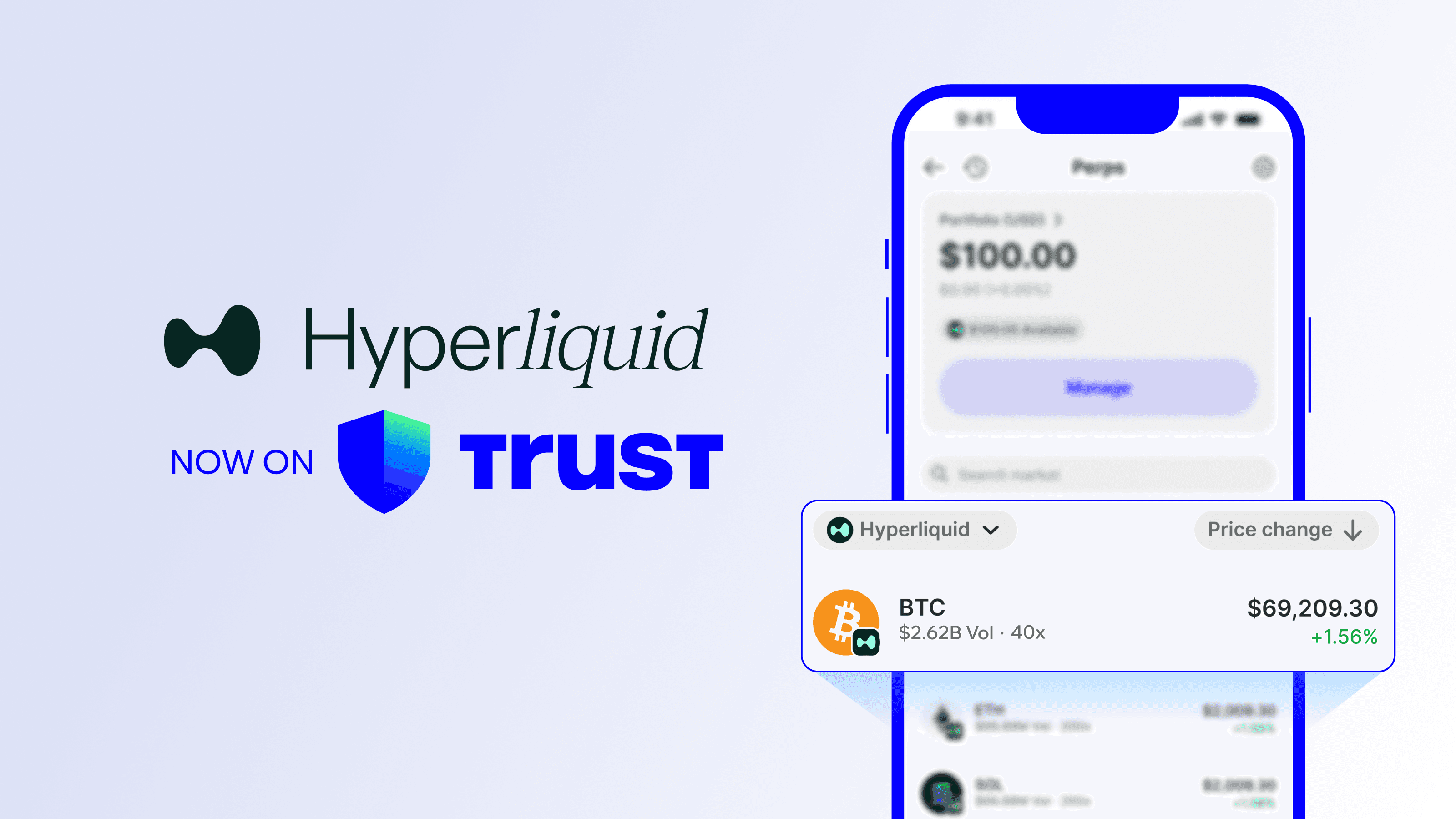
The interface is designed to be familiar to traditional traders, featuring a clean order book, charting tools, and position management. Because transactions are signed locally by your wallet, you maintain full control over your assets at all times. This non-custodial model eliminates the counterparty risk associated with centralized exchanges, making it a safer environment for managing significant capital.
Common questions about Hyperliquid trading
Hyperliquid operates as a high-performance L1 blockchain optimized for speed and low latency, distinguishing it from standard AMM DEXs. Because it is a non-custodial platform, you retain full control of your private keys at all times. The exchange does not hold your funds; instead, your assets remain in your connected wallet until you actively place a trade.
What are the fees on Hyperliquid?
Trading fees on Hyperliquid are structured around a maker-taker model. Makers, who provide liquidity to the order book, typically pay lower fees or receive rebates. Takers, who remove liquidity, pay a slightly higher fee. The exact rates vary by asset class and current market conditions, so checking the official Hyperliquid fee schedule is recommended for the most up-to-date figures.
Is Hyperliquid safe for beginners?
While the platform is secure and transparent, the trading mechanics are complex. Hyperliquid offers perpetual futures, which involve leverage and liquidation risks. Beginners should understand how margin, leverage, and funding rates work before depositing funds. The platform is non-custodial, meaning you are responsible for securing your own wallet credentials.
What assets can I trade?
Hyperliquid supports over 300 markets, including major crypto pairs like BTC and ETH, as well as commodities, indices, and forex. The platform is fully onchain, meaning all order books and trades are recorded on its native blockchain. This transparency allows users to verify positions and history directly on-chain.
How do I connect my wallet?
You can connect using any standard Web3 wallet, such as MetaMask or WalletConnect. Once connected, you can deposit assets from an external wallet or bridge funds directly. The interface is designed to be intuitive, but users should always verify the contract address and network before interacting.
No comments yet. Be the first to share your thoughts!