
Hyperliquid 2026: The State of Play
Hyperliquid has moved past the experimental phase to become one of the most significant players in the decentralized finance (DeFi) landscape. In 2026, the protocol is no longer just a niche alternative for early adopters; it is a major infrastructure layer for high-performance trading. Its transition from a fast-order execution engine to a comprehensive hub for crypto, commodities, and indices reflects a broader shift in how traders approach decentralized exchanges (DEXs).
The key to this growth is speed. Unlike traditional AMM-based DEXs that struggle with latency during high-volatility events, Hyperliquid operates on a custom L1 blockchain designed specifically for order matching. This architecture allows it to process transactions with the efficiency of a centralized exchange while maintaining the non-custodial security of DeFi. Traders who previously relied on centralized platforms for their speed now find a viable, on-chain alternative that does not require handing over control of their assets.
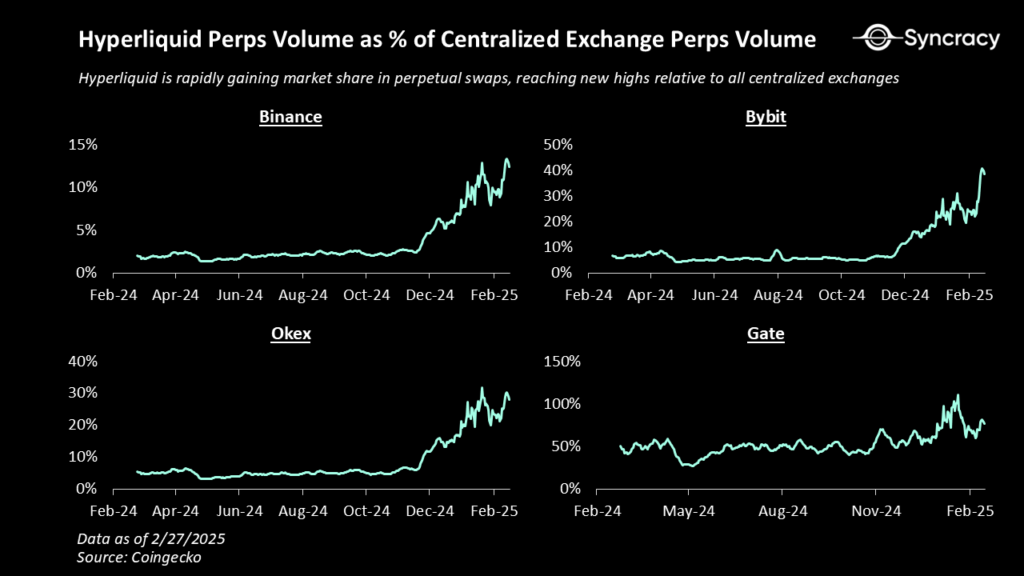
This shift is evident in the trading volumes. Early 2026 data shows Hyperliquid consistently competing with the largest centralized exchanges for daily perpetual swap volume. The protocol’s ability to handle 300+ markets without sacrificing finality has attracted institutional-grade liquidity. As the HYPE token approaches its scheduled unlocks, the focus remains on the underlying product: a trading engine that delivers centralized-like performance with decentralized integrity.
Speed and Architecture: Why Traders Stay
Hyperliquid operates as a dedicated Layer 1 blockchain rather than a smart contract deployed on an existing network like Ethereum. This architectural choice is deliberate. By building its own chain, Hyperliquid bypasses the congestion and gas fee volatility that often plague Ethereum Layer 2 DEXs. The result is a trading environment that feels closer to a centralized exchange (CEX) in terms of speed, while maintaining the non-custodial security of a decentralized protocol.
The technical backbone relies on a custom consensus mechanism designed specifically for high-frequency trading. Instead of waiting for multiple block confirmations across a fragmented network, Hyperliquid processes transactions through a dedicated validator set. This reduces latency to milliseconds, allowing traders to execute complex strategies without the slippage and failed transactions common on slower DEXs. The system handles over 300 perpetual and spot markets with minimal delay.
| Feature | Hyperliquid (L1) | Ethereum L2 DEX | Traditional CEX |
|---|---|---|---|
| Latency | Milliseconds (sub-second) | Seconds (variable) | Milliseconds |
| Custody | Non-custodial (user holds keys) | Non-custodial | Custodial (exchange holds keys) |
| Settlement | On-chain, native L1 | On-chain, L2 rollup | Off-chain ledger |
| Uptime | 24/7 automated | 24/7 automated | Subject to maintenance/downtime |
This architecture offers a distinct advantage for serious traders. You retain control of your assets—no need to trust a third party with your funds—yet you avoid the slow finality times of general-purpose blockchains. The trade-off is a more centralized validator set compared to fully decentralized networks, but for performance-focused users, the speed-to-security ratio is compelling.
The visual difference between these models is stark. Traditional CEXs offer speed but require you to surrender custody of your private keys. Ethereum L2 DEXs offer full custody but often struggle with network congestion during high-volume periods. Hyperliquid sits in the middle, using its own L1 infrastructure to deliver CEX-like execution speeds while keeping the keys in your wallet. This "best of both worlds" approach is why many high-volume traders have migrated their activity to the platform.
For traders who prioritize execution speed and reliability, Hyperliquid’s L1 design removes the friction points that typically make DEX trading frustrating. It is not just a faster version of an existing chain; it is a purpose-built financial rail designed to handle the load of modern crypto markets without compromising on the core principle of self-custody.
The $700 Million Token Unlock
On June 6, 2026, Hyperliquid executed a scheduled token unlock that added $700 million worth of HYPE to the circulating supply. For traders accustomed to the sudden sell pressure that typically accompanies large unlocks, this event represented a significant stress test for the protocol’s price stability.
The market’s reaction was notably muted compared to historical precedents. HYPE had already climbed to a record high above $62 in May 2026, suggesting that much of the unlock’s impact was priced in. However, the structural design of the network provided a mechanical buffer that prevented the expected dump.
The Assistance Fund Buyback Mechanism
The primary reason the unlock did not trigger a crash lies in the Assistance Fund. This fund recycles 99% of the trading fees generated on the platform directly into buybacks. As trading volume surged in anticipation of the unlock, the buyback pressure intensified, effectively absorbing the sell-side liquidity from the newly unlocked tokens.
This mechanism creates a self-reinforcing loop: higher trading activity generates more fees, which funds more buybacks, which supports the token price. While the unlock increased the total supply, the simultaneous increase in buyback volume neutralized the net sell pressure, keeping the market in equilibrium.
Trading Tools and Interface Experience
Hyperliquid positions itself as a hybrid between the frictionless speed of centralized exchanges and the self-custody ethos of decentralized finance. The platform achieves this through a fully onchain order book that executes trades with sub-second latency. For traders accustomed to the rigors of high-frequency or algorithmic trading, the interface mirrors the familiarity of Web2 platforms while maintaining the security guarantees of Web3.
Advanced Charting and Order Entry
The core of the trading experience is the integrated charting engine, which provides real-time data for over 300 perpetual and spot markets. Traders can analyze price action across crypto, commodities, and indices without leaving the platform. The order entry panel is designed for precision, supporting limit, market, and stop orders with a layout that minimizes input errors during volatile market conditions.
The interface prioritizes speed and clarity. Key metrics such as funding rates, open interest, and liquidation prices are displayed prominently, allowing traders to make informed decisions without switching between multiple tabs or external tools. This consolidation reduces the cognitive load during high-stakes trading sessions.
Bridging Web2 Ease and Web3 Security
What distinguishes Hyperliquid’s interface is its seamless onboarding process. Users connect their wallets via standard providers, but the trading experience itself feels centralized. Orders are processed off-chain for speed and then settled on-chain, a mechanism that eliminates the gas fees and slow confirmation times typical of other decentralized exchanges. This architecture allows for a professional-grade trading environment that does not compromise on non-custodial security.
The platform’s design philosophy ensures that the complexity of onchain settlement remains invisible to the user. This allows traders to focus entirely on strategy and execution, leveraging the performance benefits of a centralized order book while retaining control of their assets.
Hardware Wallets for Secure Access
Hyperliquid operates on an EVM-compatible architecture, meaning it integrates with the same wallet ecosystem as Ethereum. For high-performance trading, this creates a unique security consideration: your private keys must be protected offline while still allowing seamless interaction with Hyperliquid’s interface. A hardware wallet acts as a vault, signing transactions locally so your seed phrase never touches an internet-connected device.
When selecting a device, prioritize wallets with established track records in the EVM space. Compatibility is straightforward—any wallet supporting MetaMask or WalletConnect will work with Hyperliquid. However, reliability varies. You want a device that handles frequent transaction signing without lag or connectivity issues, especially during volatile market conditions.
The following hardware wallets are widely recognized for their security features and EVM compatibility. They represent the current standard for securing non-custodial assets on platforms like Hyperliquid.



As an Amazon Associate, we may earn from qualifying purchases.
Each of these devices offers distinct advantages. The Ledger Nano X provides Bluetooth for wireless connectivity with mobile devices, which can be convenient for trading on the go. The Trezor Model T features a touchscreen, offering a different user experience that some traders prefer for verifying transaction details visually. The Ledger Nano S Plus is a cost-effective entry point that retains the core security features of its more expensive sibling, though it lacks Bluetooth and requires a wired connection.
Regardless of the brand, the security of your assets ultimately depends on how you handle the recovery phrase. Never digitize your seed phrase, and never share it with support staff or enter it into a web form. Store it physically in a secure location. This single habit is the most critical factor in maintaining the security benefits of using a hardware wallet with Hyperliquid.
No comments yet. Be the first to share your thoughts!