
Hyperliquid's 2026 Derivatives Context
Hyperliquid has evolved from a specialized perpetual exchange into a high-performance Layer 1 blockchain designed specifically for on-chain finance. By moving the order book fully on-chain, the platform addresses the latency and centralization risks inherent in traditional centralized exchanges (CEXs). This architectural shift allows for 100+ perpetual and spot assets to be traded with sub-second finality, creating a unified liquidity layer that bridges the gap between decentralized security and centralized speed.
The network's performance is anchored by its native HYPE token, which secures the chain and powers governance. As the ecosystem matures in 2026, the focus has shifted from mere user acquisition to infrastructure robustness. The Hyper Foundation continues to support the development of automated trading bots and on-chain derivatives protocols, recognizing that sustainable growth requires a deep pool of institutional-grade liquidity and reliable execution engines.
For traders, this means the market context is no longer just about price discovery but about the efficiency of the underlying settlement layer. The move toward automated, bot-driven trading has increased market depth and reduced slippage, making Hyperliquid a critical node in the broader decentralized finance (DeFi) landscape. Understanding this shift is essential for analyzing how value accrues to the HYPE token and how liquidity flows between the L1 and external bridges.
Why bots dominate HYPE chain volume
Algorithmic trading bots have captured the majority of Hyperliquid’s trading volume because the network’s architecture removes the latency penalties that cripple automated strategies on other platforms. Hyperliquid operates as a dedicated Layer 1 blockchain with fully on-chain order books, a design choice that prioritizes execution speed and deterministic finality over the generalized compatibility of standard EVM chains. For high-frequency trading algorithms, this distinction is not merely technical; it is the difference between capturing a spread and watching it vanish.
The primary advantage lies in the elimination of the mempool bottleneck. On most EVM-based decentralized exchanges, bots must compete in a shared, congested mempool where transaction ordering is unpredictable and gas wars drive up costs. Hyperliquid’s native consensus mechanism processes transactions directly into its on-chain order book, allowing for sub-second finality. This deterministic execution environment enables bots to execute complex, multi-leg strategies with precision that is impossible on chains where block times and gas volatility introduce significant slippage.
This structural efficiency is critical for the types of sophisticated strategies that dominate volume. Market-making bots, arbitrageurs, and trend-following algorithms rely on tight margins and rapid turnover. By hosting the order book on-chain, Hyperliquid ensures that all liquidity is visible and accessible without the overhead of bridging assets from external liquidity layers. The result is a trading environment where code executes exactly as written, rewarding the efficiency of the algorithm rather than the speed of the network connection.
To understand the scale of this activity, one must look at the market data itself. The volume trends in the HYPE/USDC pair reflect the relentless activity of these automated systems, which often account for a significant portion of daily turnover.
Connect to the Hyperliquid API
Automated strategy deployment on Hyperliquid requires a direct connection to its decentralized Layer 1 blockchain. Unlike centralized exchanges that rely on opaque internal databases, Hyperliquid maintains fully onchain order books. This architecture demands a specific developer workflow: you must authenticate with private keys and submit signed transactions directly to the network rather than relying on session-based cookies or third-party proxies. The following steps outline the standard procedure for initializing your API environment and establishing a secure link to the mainnet.
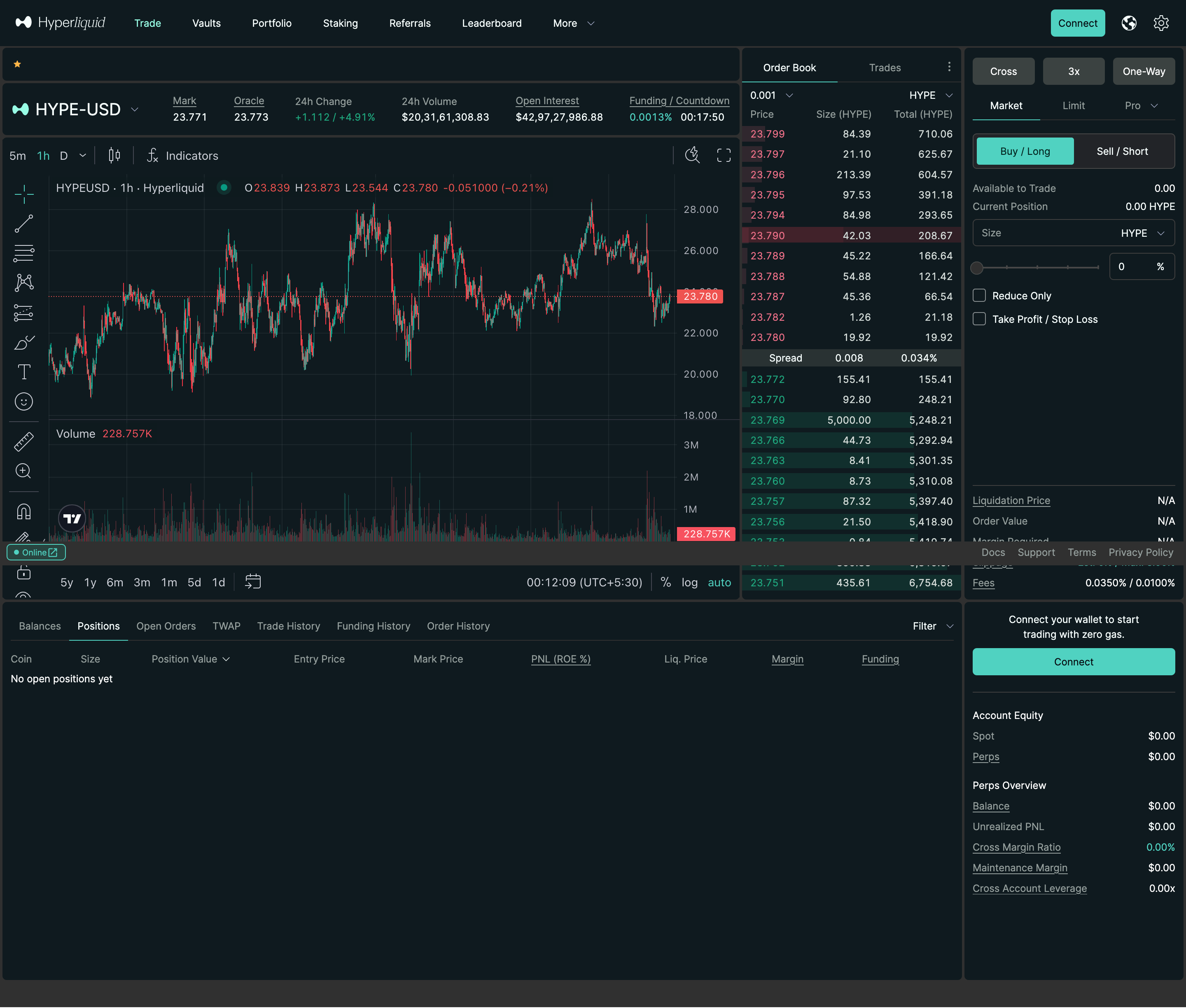
Begin by accessing the Hyperliquid developer portal at app.hyperliquid.xyz. Navigate to the developer settings to generate a new API key pair. You will receive a public key for identification and a private key for signing transactions. Treat the private key with the same security rigor as your wallet seed phrase; anyone possessing it can control your strategy and assets. Store these credentials in an environment variable file that is excluded from version control.

Import the official Hyperliquid Python or TypeScript SDK into your project. Initialize the client instance by passing your API key and setting the environment flag to mainnet. This client handles the complex serialization of your trading strategies into the specific message format required by the Hyperliquid consensus layer. Ensure your local system clock is synchronized, as timestamp-based replay protection is enforced on the network level.

Before deploying capital, execute a read-only query to verify your connection. Request your current wallet balance and open positions through the SDK. This step confirms that your private key is valid and that your client is communicating with the correct node. If the query returns zero or errors, check your network connectivity and ensure you are not accidentally pointing to a testnet environment when intending to trade on mainnet.
Deploy a minimal test order to validate the end-to-end workflow. Use a small size and a wide limit price to minimize market impact and execution risk. Monitor the transaction hash on the blockchain explorer to confirm the order is recorded onchain. Once the test order fills or cancels, you have verified that your signing logic, network connection, and fee payment mechanisms are functioning correctly.
| Feature | CEX API | Hyperliquid API |
|---|---|---|
| Authentication | Session token / API Key | Ethereum-style private key signature |
| Order Storage | Offchain database | Fully onchain order book |
| Execution Speed | Microseconds (internal) | Block-time latency (L1 finality) |
2026 price forecasts and risks
Market analysts project HYPE to trade between $19.85 and $58.45 in 2026, with consensus targets clustering near $37–$54. Current trading data shows a 66.5% probability assigned to the $54 target, reflecting cautious optimism anchored by recent performance. HYPE has rallied 61% year-to-date, trading in the $40–$44 range, but this momentum faces headwinds from broader regulatory scrutiny and the technical complexity of on-chain derivatives.
The divergence in forecasts highlights the binary nature of this asset. Bullish scenarios rely on sustained volume growth in perpetual trading and potential institutional adoption, while bearish models account for regulatory crackdowns on decentralized exchanges. A $100 price point would require a 2.5x expansion in market capitalization, a move that analysts deem possible only if Hyperliquid captures significant market share from centralized competitors.
| Analyst Source | 2026 Low Target | 2026 High Target | 2026 Average/Consensus | Key Driver |
|---|---|---|---|---|
| Coinpedia | $19.85 | $54.87 | $37.36 | Volume growth & adoption |
| Cryptopolitan | $25.00 | $58.45 | $42.00 | Peak trading activity |
| Polymarket (Implied) | $35.00 | $54.00 | $44.50 | Market probability weighting |
| Kraken (Model) | $30.00 | $61.08 | $45.54 | 5% annual growth rate |
Regulatory risk remains the primary variable that could invalidate these projections. While the technical infrastructure of Hyperliquid is robust, the legal status of its token and derivatives in major jurisdictions is evolving. Traders should monitor legislative developments closely, as any adverse ruling could suppress price targets significantly below the current consensus.
No comments yet. Be the first to share your thoughts!