

In the cutthroat arena of perpetual decentralized exchanges in 2026, Hyperliquid stands unchallenged, boasting a TVL surpassing $6 billion in January while clones like Aster lag at $2.2 billion. This gap manifests starkly in trading volumes: Hyperliquid's $2.93 trillion in annual contract volume for 2025 dwarfs Aster's $791 billion. Clone perp DEXs, despite frantic imitation, fail to ignite comparable hyperliquid volume dominance. Their persistent perp dex failures stem from three insurmountable barriers, rooted in Hyperliquid's foundational advantages.
Hyperliquid's ascent, fueled by its custom Layer-1 blockchain and HyperBFT consensus, delivers sub-second finality and fully on-chain order books. Daily active users hit 37,000 to 60,000 in late 2025, creating a self-reinforcing flywheel where trading fees fund buybacks, tightening liquidity further. Clones, scrambling in this shadow, grapple with structural deficits that erode their edge.
Inferior Microstructure: Wider Spreads and Execution Lag
At the heart of hyperliquid clone perps downfall lies their hyperliquid microstructure inadequacy. Hyperliquid's optimized orderbook, powered by HyperCore and HyperEVM, achieves microscopic spreads and lightning execution, luring high-frequency traders who demand precision. Clones cannot replicate this; their designs yield wider spreads and sluggish fills, repelling pros who prioritize microseconds.
Consider open interest: Hyperliquid held $8.014 billion in September 2025, nearly two-thirds of the top four platforms combined. Inferior clones suffer slippage that balloons during volatility, eroding trader confidence. As noted in technical analyses, Hyperliquid's clearinghouse and funding mechanisms ensure resilient microstructure, while rivals falter under load.
Hyperliquid vs. Clone Perp DEXs: TVL, Volume, and Open Interest
| Platform | TVL | Trading Volume (2025 Annual) | Open Interest (OI) |
|---|---|---|---|
| Hyperliquid | $6B | $2.93T | $8B |
| Aster | $2.2B | $791B | Lower |
| Other Clones | Fragmented | Fragmented | Fragmented |
Weak Distribution Strategies: User Acquisition Stumbles
Hyperliquid nailed distribution early, blending viral incentives with seamless onboarding to cultivate organic flow. In 2026's saturated perp dex landscape, clones deploy generic airdrops and paid marketing, yielding shallow engagement. Lacking Hyperliquid's playbook, they battle churn rates exceeding 70%, as users flock to proven liquidity.
This distribution chasm amplifies in a post-CEX failure era, where trust hinges on sustained activity. Hyperliquid's community-driven growth, absent in clones, sustains 50,000 and daily traders, while competitors scrape sub-10,000 figures. Without nailed tactics, hyperliquid clone perps remain echo chambers, starved of volume momentum.
Liquidity Fragmentation: The Cross-Chain Trap
Clones' reliance on cross-chain bridges and multi-pool setups breeds perp dex liquidity moat erosion. Hyperliquid's concentrated, native liquidity fosters deep orderbooks immune to fragmentation. Rivals face drained pools from bridging delays and exploits, crippling bootstrap efforts in 2026's high-stakes trading.
Whale activity underscores this vulnerability: in March 2025, Hyperliquid's HLP pool absorbed whale leverage shocks without fracturing, thanks to its unified liquidity layer. Clones, fragmented across chains, see liquidity evaporate during dumps, as bridging frictions amplify slippage by 20-50 basis points on average. This perp dex liquidity moat deficit traps them in a vicious cycle, where thin books beget more thinness.
Bitcoin Technical Analysis Chart
Analysis by Evan Mitchell | Symbol: BINANCE:BTCUSDT.P | Interval: 1D | Drawings: 7
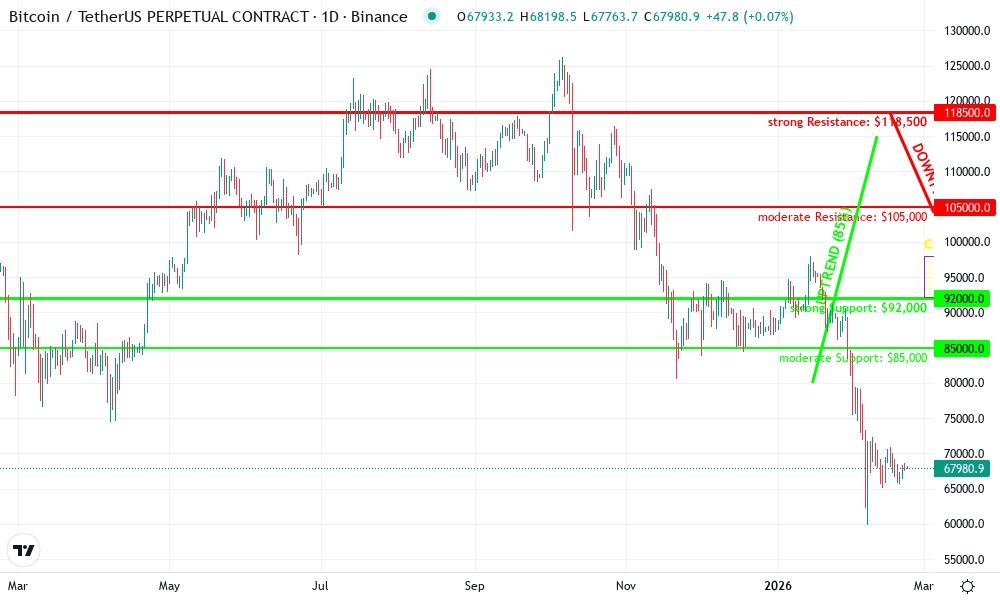
Technical Analysis Summary
In my conservative style as Evan Mitchell, a CFA charterholder specializing in crypto risk management, annotate the BTCUSDT.P chart with a primary downtrend line from the February 2026 peak near 118,500 to the current March 2026 lows around 92,000, signaling a healthy correction within the broader uptrend. Add horizontal lines at key support (90,000-92,000) and resistance (105,000), a 0.618 Fibonacci retracement from January lows to February highs for potential reversal zones, rectangles for the ongoing consolidation range post-pullback, and callouts highlighting decreasing volume on the downside with MACD bearish divergence. Use arrow_mark_down at the breakdown point around mid-February 2026 to emphasize caution in perps trading amid Hyperliquid's dominance driving volumes but introducing leverage risks.
Risk Assessment: medium
Analysis: BTC perps exhibit high volatility from DEX flywheel effects but correction risks persist due to leverage and fragmentation; low tolerance aligns with waiting for confirmation.
Evan Mitchell's Recommendation: Observe support at 92k with <1% risk per trade; prioritize compliant, low-leverage positions in Hyperliquid-led ecosystem.
Key Support & Resistance Levels
📈 Support Levels:
- $92,000 - Recent March lows aligning with 0.618 fib retracement strong
- $85,000 - Psychological support and prior consolidation base moderate
📉 Resistance Levels:
- $105,000 - Immediate resistance from early March highs moderate
- $118,500 - February 2026 peak, strong overhead supply strong
Trading Zones (low risk tolerance)
🎯 Entry Zones:
- $92,500 - Confirmation of support hold with volume pickup, low-risk long in line with DEX uptrend low risk
🚪 Exit Zones:
- $105,000 - Profit target at resistance confluence 💰 profit target
- $89,500 - Stop loss below key support to limit downside 🛡️ stop loss
Technical Indicators Analysis
📊 Volume Analysis:
Pattern: Decreasing volume on pullback
Suggests weakening selling pressure, potential base formation amid Hyperliquid volume dominance
📈 MACD Analysis:
Signal: Bearish crossover with divergence
Momentum slowing, confirming correction but not trend reversal
Applied TradingView Drawing Utilities
This chart analysis utilizes the following professional drawing tools:
Disclaimer: This technical analysis by Evan Mitchell is for educational purposes only and should not be considered as financial advice. Trading involves risk, and you should always do your own research before making investment decisions. Past performance does not guarantee future results. The analysis reflects the author's personal methodology and risk tolerance (low).
Data from DeFi Llama reveals Hyperliquid's market share erosion from 60% in January 2025 was temporary; by late 2025, it reclaimed dominance through unfragmented pools. Clones like Aster, juggling EVM compatibility and cross-chain oracles, incur latency penalties that high-volume traders shun. Hyperliquid's HyperBFT sidesteps these entirely, channeling all flow into one resilient venue.
| Metric | Hyperliquid (2026) | Aster and Clones (Avg) |
|---|---|---|
| Daily Volume | $8B and | $1-2B |
| Open Interest | $8B | $2-3B combined |
| Slippage (Volatile Mkts) | and lt;5bps | 15-30bps |
These disparities compound: inferior microstructure repels HFTs, weak distribution starves inflows, and fragmentation starves depth. Together, they cement Hyperliquid's hyperliquid volume dominance, leaving hyperliquid clone perps as footnotes in 2026's perp DEX wars.

The Flywheel That Clones Can't Spin
Hyperliquid's edge isn't static; it's a compounding machine. Trading fees, amplified by superior microstructure, fuel HYPE token buybacks and burns, which in turn lure more capital. Daily users stabilizing at 50,000 and reflect this retention, versus clones' fleeting spikes from gimmicky incentives. In a landscape scarred by CEX collapses, traders gravitate to proven resilience, not replicas.
Examine the onchain orderbook trend: as Unchained notes, perp DEXs are clawing CEX share through native execution. Hyperliquid leads this charge, its architecture dissecting funding rates and clearing with surgical precision. Clones, outsourcing to external market makers, watch spreads balloon when support wanes, as armaniferrante warns. Without Hyperliquid's integrated stack, they can't sustain the organic flow essential for liquidity bootstraps.
For traders eyeing 2026, this triad of failures signals caution. Perp dex failures aren't mere execution slips; they're structural. Hyperliquid's concentrated moat demands clones innovate beyond mimicry, perhaps via novel primitives. Yet history favors first-movers who nail the basics: distribution, microstructure, cohesion. Platforms chasing shadows risk irrelevance as volumes concentrate further.
Discipline dictates allocating to venues with verifiable depth. Hyperliquid's metrics provides $6B TVL, $2.93T annual volume, aren't anomalies; they're the benchmark. Clones must bridge not just chains, but capability gaps, to challenge this hegemony. Until then, the perp DEX throne remains occupied.




No comments yet. Be the first to share your thoughts!